


Biber
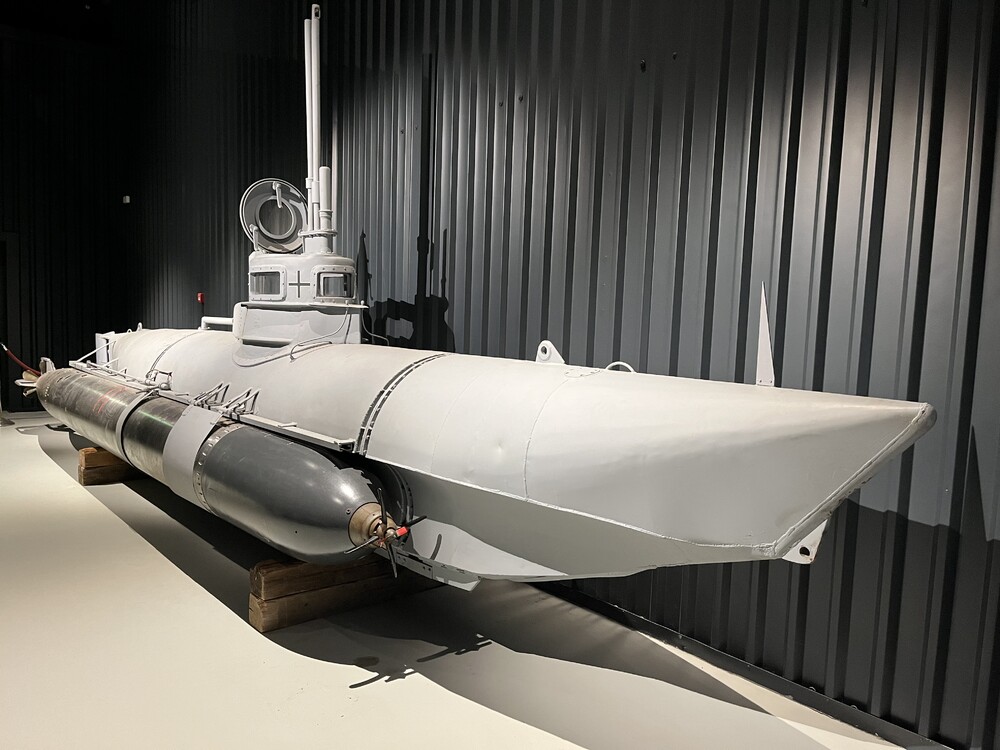
The Biber (German for beaver) was a one-man midget submarine of the German Kriegsmarine during the Second World War. In total, 324 units were built and commissioned. The Biber was part of the so-called Kleinkampfmittel: small, specially developed weapons intended to attack Allied shipping with limited resources.
The submarine was operated by a single crew member, who had to act simulaneously as pilot, navigator, and weapons officer. The Biber was equipped with both a petrol engine for use on the surface and an electric motor for silent propulsion underwater. Its maximum speed ranged between 5.25 and 6.5 knots. Two torpedoes could be carried on either side of the hull.
The plan was to transport Bibers in large numbers over land by train and truck to coastal areas, where they could be deployed against the Allied invasion fleet. Despite their limited range, they were intended to launch surprise attacks on enemy ships from these locations.
The example displayed in the museum, Biber 205, has a special modification. An additional fuel tank is installed in the bow of the hull. This modification was only fitted to Bibers operating from the Rotterdam area to the Western Scheldt, where they were used to attack Allied shipping.
Biber 205 most likely belonged to K-Flottille 266, a unit active between October 1944 and March 1945. This flotilla was transferred from Rotterdam to Emmerich, Germany, in late 1944 or early 1945. From Emmerich, several Biber operations were carried out in January and February 1945.

